 Foto von E. Diop auf Unsplash
Universitätslehrgang
DIPLOMA COURSE: Trauma-Sensitive Psychosocial Work in Global Contexts
When working in international humanitarian aid, displacement contexts, or crisis-affected regions, professionals are routinely confronted with the deep impacts of collective and individual trauma. Translating psychological theory into effective, culturally sensitive field practice requires specialized methodologies. This diploma course provides a comprehensive and practice-oriented introduction to trauma-sensitive psychosocial work in global contexts.
Designed for professionals working in health, social, humanitarian, educational, human rights and community settings both in European contexts (with an international or inter-cultural focus of work) and in contexts of the Global South, the course equips participants with a sound theoretical foundation as well as practical skills to respond effectively to trauma, crisis, and psychosocial needs across diverse cultural and resource environments.
The curriculum focuses on cross-cultural psychological practices, community-based resilience strategies, and systemic responses to collective and individual trauma in crisis-affected regions.
Course Details
General Information
In international cooperation, humanitarian aid, and peacebuilding, sustainable success often depends on addressing the invisible wounds of conflict, displacement, and disaster. Integrating mental health and psychosocial support (MHPSS) into field operations is no longer optional—it is a core requirement for impactful work. This diploma program is specifically designed to translate complex trauma theory into adaptable, field-ready strategies. Participants will analyze systemic and individual trauma through a global lens, learning how to build resilient communities while respecting diverse cultural frameworks.
The programme will be offered both in person and fully online and is structured into four modules, combining evidence-based psychological frameworks with interactive learning, oriented along international research on trauma psychology as well as international standards for mental health and psychosocial support (MHPSS) and evidence-based intervention tools.
Key Competencies Acquired
Field-Ready Interventions: Building practical skills for acute crisis response, including Psychological First Aid (PFA), stabilization techniques, and Problem Management Plus (PM+)
Cross-Cultural Application: Applying trauma-informed and resilience-oriented approaches across diverse professional and regional contexts
Community-Led Resilience: Designing and implementing trauma-sensitive and resilience-oriented practices at group, community, and organizational levels, including strengthening collective resilience, Self-Help Plus (SH+), and peer support
Operational Self-Care: Reflecting on helper wellbeing and professional limitations, including self-care, self-regulation, and secondary stress
Target Groups
The course is designed for professionals working in, or engaging with, contexts affected by crisis, conflict, displacement, and other high-stress conditions, both internationally and within European settings.
It brings together participants from diverse professional and cultural backgrounds, including those working directly in humanitarian or low-resource environments, as well as those involved in psychosocial, educational, health, or community-based services in more stable contexts in Europe with an international and/or intercultural focus.
Applications are welcome from a wide range of professionals, including but not limited to the following groups:
- Psychologists and counsellors
- Social workers
- Healthcare professionals (e.g. nurses, doctors, public health workers)
- Educators and school staff
- NGO and humanitarian workers
- Staff of international and local organizations
- Pastoral workers and faith-based practitioners
- Child protection officers
- Professionals working with refugees and displaced populations
- First responders (e.g. police, emergency personnel)
- Other related professionals in humanitarian or social fields
Admission Requirements:
Applicants should meet one of the following criteria:
A completed secondary education (high school diploma) combined with relevant professional experience in fields such as health, social work, education, humanitarian work, or community development
or
A Bachelor’s degree (or equivalent) in a relevant field (e.g. medicine, psychology, social sciences, education, health, social work, theology, or related disciplines).
Curriculum Structure
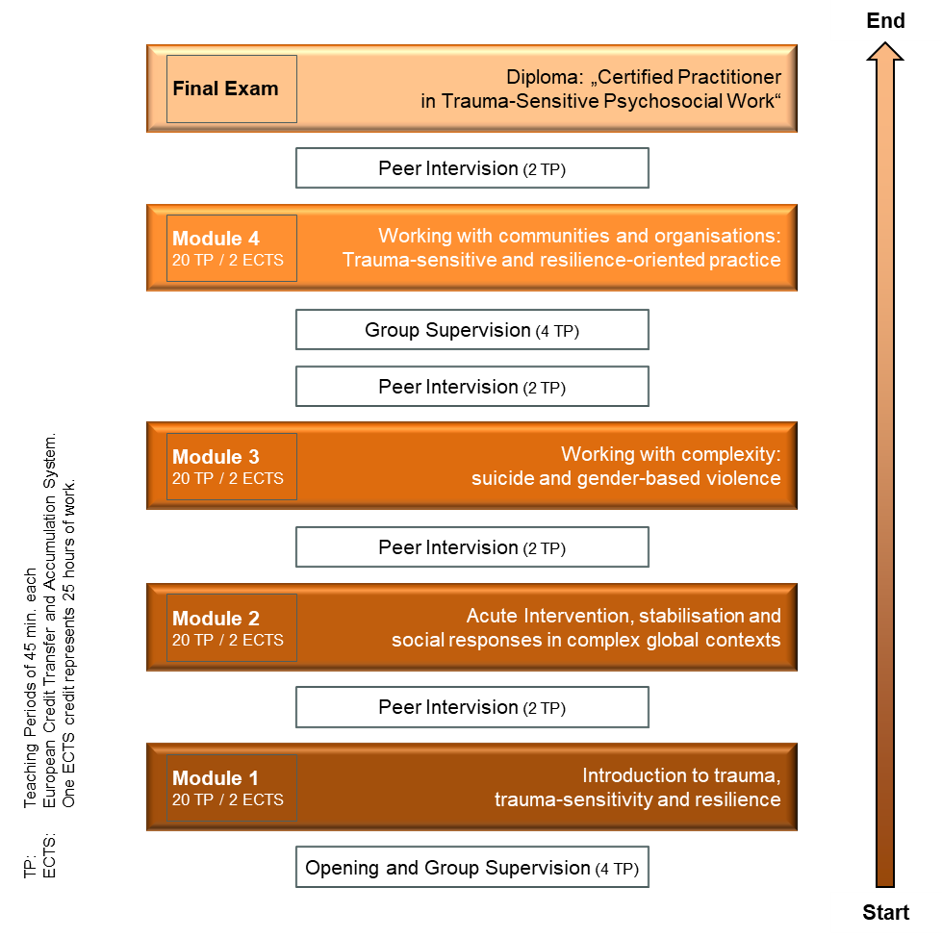
The course is divided into four modules, which build upon one another. In total, the course with its four modules comprises 80 teaching periods, which corresponds to 5 semester hours or 8 ECTS credits.
Case Supervision
The course integrates four sessions of structured peer intervision and two sessions of group supervision to support reflective practice.
Participants work in triadic peer groups after each module of the course, engaging in guided case discussions and personal self-reflection. In addition, two facilitated group supervision sessions provide space to explore needs in terms of the over-all objective of the course, complex situations, ethical dilemmas, and contextual challenges whereby the first supervision will take place before the first module and after the third module.
Curriculum
The course comprises a total of four modules, which build upon each other and must be completed in the specified order. The course management decides on any exceptions.
An initial group supervision session will be conducted prior to the first module to assess participants’ needs and professional contexts. Based on this assessment, specific emphases within the modules may be adapted to the respective group. Where appropriate, particularly in more homogeneous groups, additional profession-specific content may be incorporated. Such adaptations will remain within the overall curriculum framework; the core structure, sequence, and learning objectives of the four modules will not be altered.
The course includes 8 units of peer intervision and 8 units of group supervision.
In addition to the four modules, peer intervisions and group supervisions, it is possible to take a final assessment for certification to complete the course.
After successfully completing the final examination, the course concludes with diploma “Certified Practitioner in Trauma-Sensitive Psychosocial Work”.
Certification
After successfully completing the final examination, the course concludes with diploma “Certified Practitioner in Trauma-Sensitive Psychosocial Work”.
Financial Information
Coming soon
Meet our trainers
 Foto: Markus Gradwohl
Mag.a Dr.in Johanna Gerngroß
Klinische und Gesundheitspsychologin, Notfallpsychologin
 Foto: Simone Lindorfer
Dr.in Simone Lindorfer
Katholische Theologin, Psychologin, systemische Familientherapeutin und Traumatherapeutin
You might also be interested in these courses
Traumapädagogik und traumazentrierte Fachberatung
Vielen Menschen erleiden im Laufe ihres Lebens psychische Traumatisierungen. Auch Kinder und Jugendliche sind extremen Belastungen wie (sexualisierter) Gewalt, Vernachlässigung, Verlusten oder Flucht ausgesetzt. Lange Zeit wurde das Thema „Traumatisierung“ in sozialen und pädagogischen Arbeitsfeldern zu wenig beachtet. Erkenntnisse aus der Psychotraumatologie, der Hirn- und Bindungsforschung unterstreichen jedoch die Notwendigkeit eines neuen traumaspezifischen Fallverstehens. Sozialpädagog*innen und andere pädagogische Fachkräfte können stabilisierend und ressourcenorientiert mit belasteten Heranwachsenden und traumatisierten Menschen arbeiten.
Psychosoziale Beratung bei Krise und Trauma
Dieser Lehrgang vermittelt ein tiefgreifendes Verständnis für Psychotraumata und schwere Krisen bei Kindern, Jugendlichen und Erwachsenen. Detaillierte Kenntnisse der Psychotraumatologie, Neurobiologie, Traumaverarbeitung und Resilienzforschung ermöglichen eine kompetente traumasensible Beratung und Begleitung von schwer belasteten Menschen. Die Vermittlung von anwendungsorientierten Interventionen ermöglicht eine direkte Umsetzung der Lehrgangsinhalte in die eigene Praxis.
Notfallpsychologie und psychologisches Krisenmanagement
Wer hilft, wenn das Leben plötzlich auseinanderbricht? Wenn man gerade den liebsten Menschen verloren hat? Oder bei einem Unfall Schreckliches mitansehen musste?
Notfälle und traumatische Ereignisse treffen die meisten Menschen völlig unvermittelt, können heftige psychische Reaktionen hervorrufen und manchmal auch mittel- und langfristige Folgen für die Betroffenen haben.
Im Universitätslehrgang „Notfallpsychologie und psychologisches Krisenmanagement“ wird fundiert und praxisorientiert das notfallpsychologische Wissen zur Verfügung gestellt, um Menschen in akuten Belastungssituationen und nach traumatischen Erlebnissen kompetent zu unterstützen.
Suizidprävention plus - Schulung zum "Gatekeeper der Suizidprävention"
Im Umgang mit suizidalen Personen besteht häufig große Unsicherheit. Fachkräfte aus dem psychosozialen, therapeutischen, medizinischen oder pädagogischen Bereich fühlen sich oft auf solche Situationen nicht ausreichend vorbereitet. Die Sorge etwas falsch zu machen und Mythen über das Thema Suizidalität verhindern ein professionelles Handeln und können dazu führen, dass sich Fachkräfte als zu wenig kompetent und in weiterer Folge schuldig fühlen.
Dieser Lehrgang bietet das Hintergrundwissen und Handwerkszeug, um Menschen in suizidalen Krisen angemessen und kompetent zu begegnen und dabei eine hilfreiche Haltung einzunehmen, ohne die eigenen Grenzen außer Acht zu lassen.
 Foto von Natalia Deriabina auf Shutterstock
Sexualpädagogik und sexuelle Bildung
Sexuelle Bildung fördert laut Weltgesundheitsorganisation (WHO) Respekt, Toleranz und Empathie für andere, die Gleichstellung der Geschlechter, kritisches Denken, Selbstvertrauen und Selbstwertgefühl, die Freude an der Sexualität sowie respektvolle Beziehungen. Es geht um mehr als um altersentsprechende „Aufklärung“. Eine zeitgemäße Sexualpädagogik versteht Sexualität als ein positives, dem Menschen innewohnendes Potenzial.
Die Vielfalt der Lebensformen ist ein Thema, welches sich durch den gesamten Lehrgang zieht. Dabei werden z.B. konstruktive Perspektiven auf Geschlecht, Gender und Sexualität vermittelt, um die Grundzüge einer Sexualpädagogik und sexuellen Bildung der Vielfalt besser verstehen zu können und für versteckte heteronormative Denkstrukturen, Vorannahmen oder Vorurteile im pädagogischen Alltag sensibilisiert zu sein.